

A new layer of trust in tailings governance: Enhancing risk assessment & safety

Tailings governance is at a pivotal moment.
Around the world, the mining industry has witnessed numerous tailings dam failures, leading to growing concerns about their impact on communities and ecosystems.
According to a recent journal paper, comprehensive historical data show that from 1961 to the end of 2022, a total of 154 major tailings dam accidents occurred worldwide, with 144 documented cases between 1961 and 2020. These incidents have resulted in not only severe environmental devastation but also significant human casualties.

The technical and engineering causes of tailings dam failures have been well researched. Slope instability, overtopping, and foundation stability were identified in a study by Bowker and Chambers (2017) as the three most common causes of the largest dam failures over the last 100 years.
Although the mining industry has made significant progress in embedding environmental and social governance (ESG) into business strategy over the past three decades, attention to the risks associated with waste disposal sites — particularly tailings storage facilities (TSFs) — has only gained momentum more recently.
There is a realisation that managing tailings is not just an engineering challenge but poses a risk with significant societal consequences. Critically, however, traditional methods often fall short in providing comprehensive oversight and are now facing significant scrutiny due to their limitations.
As such, the governance of tailings facilities is undergoing significant changes, driven by growing environmental concerns and increasing regulatory pressures.
Why traditional monitoring methods fall short
Traditional monitoring methods often struggle with limitations — their infrequency and localised nature hinder comprehensive risk assessment. The heavy reliance on site inspections can also be costly and time-consuming.
Fundamentally, traditional methods often miss the bigger picture. They can't always detect early signs of structural changes in tailings dams, and as a result, these blind spots increase the risk of unforeseen failures.
Key limitations of traditional methods include:
Limited data frequency and scope
High costs and resource demands
Dependency on human observations, leading to potential errors
Relying solely on such methods can compromise safety and compliance efforts.
The transformative power of independent satellite data
Emerging technologies, such as satellite monitoring, are transforming the industry, supporting greater accountability, with broader and more reliable coverage, offering a more comprehensive view than conventional ground surveys.

Satellite data offers a unique vantage point, providing consistent and comprehensive imagery from above. This data ensures continuous assessment of vast areas, providing a broader view sometimes missed by ground-based methods.
What’s more, historical datasets provide a continuous, high-resolution record of deformation, revealing past trends that short-term monitoring cannot capture.
Moreover, satellite monitoring is scalable, easily adapting to the monitoring needs of both small and large tailings sites.
The use of remote sensing technology enables the detection of even minor shifts and deformations, with this early detection crucial for preventing potential failures. As such, it allows engineers to act promptly, reducing risks significantly.
Key benefits of satellite data include:
High-frequency data acquisition
Scalability for varied project sizes
Historical data revealing past trends
Building transparency through independent satellite data
Independent satellite imagery enhances transparency in tailings dam governance by providing objective, verifiable insights into site conditions.
It supports on-the-ground assessments, improves reporting accuracy, and strengthens communication with stakeholders and regulators, while also contributing to ESG governance frameworks through timely, high-resolution environmental data.
By offering a clearer, unbiased view of facility conditions, satellite monitoring enables more informed decision-making, greater operational confidence, and increased trust across all stakeholders.
This enables:
Independent verification of site conditions
Improved stakeholder communication
Greater transparency and accountability
Integrating satellite monitoring into existing systems: a more proactive approach to risk management
Satellite monitoring is most effective when integrated alongside existing tailings management systems.
Rather than replacing traditional methods, it complements them with consistent, high-frequency data that enhances visibility across a site.

Integrated into existing workflows, independent satellite monitoring enhances tailings safety, compliance, and operational oversight by strengthening monitoring capabilities, enabling faster response times, and supporting better strategic planning.
Continuous, objective remote sensing data allows geotechnical teams to detect changes early, respond proactively, and make more informed decisions alongside traditional monitoring methods.
Key steps include:
Tailoring solutions to site-specific requirements
Integrating continuous satellite data into existing systems
Supporting faster operational response and planning
Real-world applications
At Geofem, our team of experts helps make proactive, informed decisions with satellite intelligence insight:
Displacement monitoring
Differential Synthetic Aperture Radar (DInSAR) techniques are used for displacement measurement and monitoring of assets with millimetric accuracy.
Soil Moisture Measurement
Satellite image analysis is used to measure soil moisture changes over time and identify areas of poor drainage for proactive remediation.
Geohazard susceptibility Satellite images, geographical information systems, statistical analysis and engineering expertise provide susceptibility mapping for geohazards such as landslides.
Satellite insights are combined with geotechnical expertise and analysis to deliver a clear, comprehensive understanding of asset performance and evolving site conditions through in-depth reporting.
Mining risk, clearly interpreted
On 9 March 2018, a section of the Cadia Valley tailings dam in New South Wales Australia collapsed, releasing tailings into an adjacent storage facility. Geofem later investigated how early this failure could have been detected using regular satellite SAR monitoring.
InSAR analysis of Sentinel-1 descending SAR data revealed ground movement at the site of the collapse. It also revealed that displacement increased at a consistent rate for 2 years until 8th January 2018. At this point, movements accelerated to about double the prevailing two-year rate.
In the following two acquisitions to 25th February 2018, the velocity more than doubled again to 214mm/year.

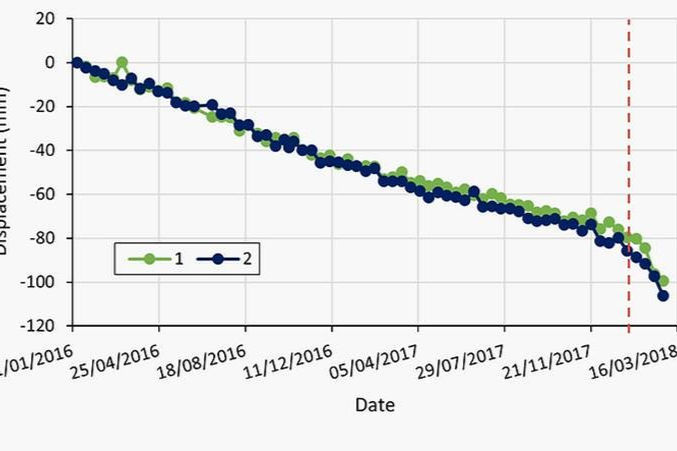
Depending on the alert thresholds set for velocity or acceleration, operators of the NTSF could have been warned about the increasing ground movement one to two months before the collapse.
This early warning would have given the operators enough time to investigate the issue on-site and potentially adjust operations to avoid the failure.
A new standard for responsible tailings management
Satellite technology is widely reshaping how tailings are monitored and managed. By providing independent and transparent insights, it offers a new level of assurance in governance practices.
Adopting these technologies enhances safety and reduces risks, aligning with the industry's shift towards digital solutions.
As satellite monitoring becomes integral to operations, it sets a benchmark for responsible and sustainable tailings management, benefiting both companies and communities alike.
Ready to see how our technology can support improved mine management through enhanced risk assessment and geotechnical safety? Get in touch with the Geofem team today.


Comments